Spatial Biology and Integrated Genomics (SBIG) Shared Resource
University of Georgia
Contact: SBIG Team >
The Spatial Biology and Integrated Genomics (SBIG) Shared Resource at the University of Georgia School of Medicine provides researchers with unparalleled access to single-cell multiomics and high-plex spatial imaging capabilities.
The core provides an end-to-end multiomics pipeline, enabling researchers to map gene and protein expression from single-cell suspensions up to intact tissue with cellular and sub-cellular resolution.
Equipment in the core:
- BD Rhapsody™ HT Xpress System & Scanner: A high-throughput single-cell isolation and analysis platform utilizing microwell cartridge technology for parallel multiomic profiling of tens of thousands of single cells, complete with automated quality control and cell-counting visualization.
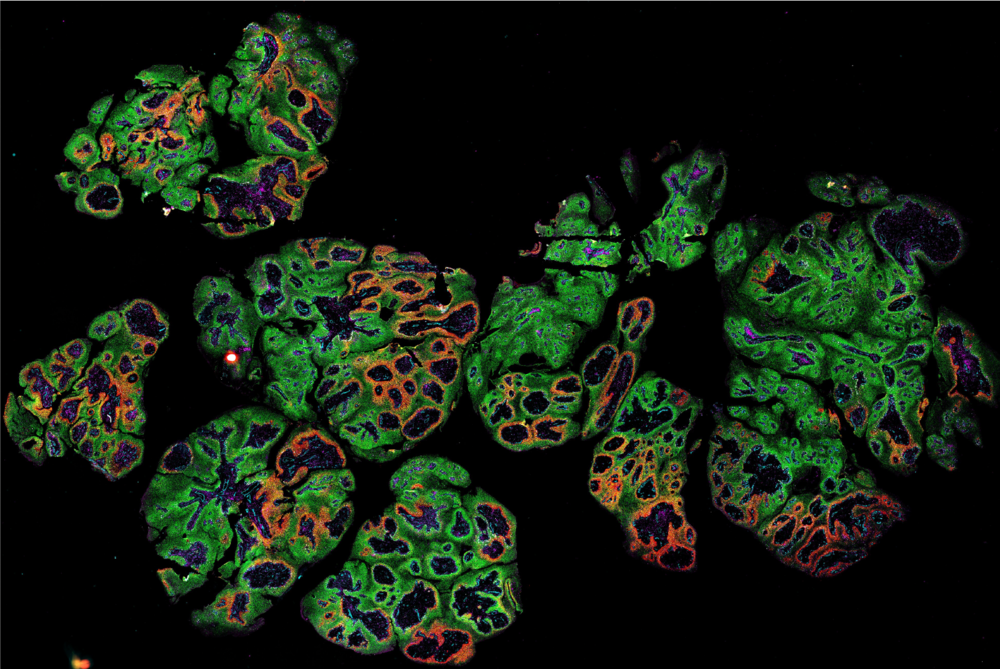
- RareCyte Orion™: High-throughput, single-round automated fluorescence imaging utilizing up to 20 channels for protein profiling of large patient cohorts.
- Bruker CosMx® Spatial Molecular Imager (SMI): High-sensitivity, single-cell multiomic analysis capable of mapping up to 18,000 mRNA transcripts and 64 proteins at subcellular resolution.
- Bruker GeoMx® Digital Spatial Profiler (DSP): Morphology-driven, highly reproducible profiling of distinct tissue compartments, detecting up to 1,200 proteins and 18,000 mRNA transcripts.
- Parhelia Spatial Station™: Fully automated, standardized fluidic processing to ensure reproducible sample preparation and protect precious tissue specimens.
- Indica Labs HALO®: Advanced image analysis suite featuring specialized spatial modules for cell proximity, neighborhood analysis, and quantitative metadata extraction.
Services Offered: Experimental design consults, single-cell partition and library preparation, automated sample processing, high-plex spatial transcriptomic and proteomic scanning, cloud-based data storage/access via OMERO plus™, pathology consultation and interpretation, and quantitative spatial/single-cell bioinformatics.
More about this core facility at UGA's website »
This core is open to investigators across the Georgia research ecosystem.
< Back to GRA Core Exchange facilities