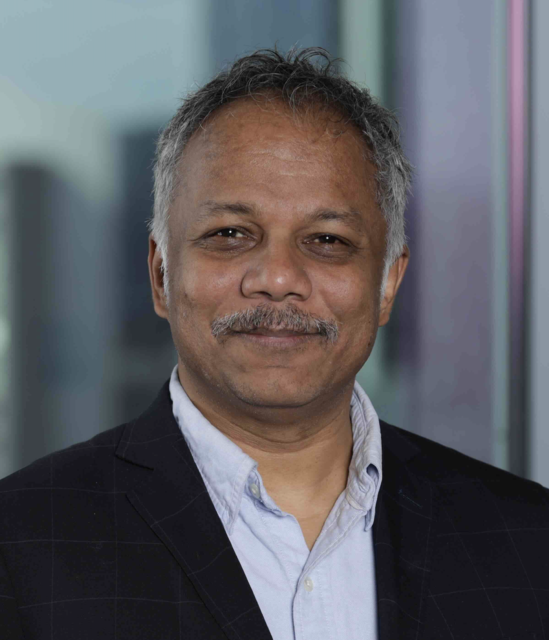
Sriram Vishwanath, Ph.D.
Telecommunications
Georgia Institute of Technology
Recruited: 2025
Information theorists are a rare breed – they explore the mathematics of information to build the foundation of systems that connect wireless networks, cryptocurrencies, AI and modern computing. The constant flow of information that defines our world wouldn't exist without them.
Sriram Vishwanath is one of the most prominent information theorists working in the field today. He innovates across three interconnected realms: artificial intelligence, cryptocurrency and wireless systems. His work evolves the flow of information and shapes the design of new systems to manage this flow.
Wireless Foundations
Vishwanath's career breakthrough came during his PhD when he and his collaborators reconceptualized information flow in wireless communications. Their 2003 paper on new algorithms and architectures established mathematical models calculating wireless capacity limits across different scenarios. This work revealed optimal antenna configurations and transmission speeds for emerging cellular systems. His insight into multi-antenna channels led to improvements in MIMO (multiple input, multiple output), now the foundation of modern wireless systems.
As part of this work, Vishwanath tackled maximizing data rates when broadcast signals interfere with multi-access channels. Together with his collaborators, he discovered a "duality," a mathematical relationship between broadcast channels (one transmitter to many users) and multi-access channels (many users to one receiver). This landmark finding gave engineers a blueprint for managing wireless communication systems, transforming how we coordinate users in real time.
At the University of Texas at Austin, Vishwanath built a 21-year career researching wireless networks. With collaborators, he worked on methods to quantify and overcome pilot contamination, signal interference from overlapping transmissions in crowded wireless environments.
Decentralized Systems and Blockchain
Starting 2013, Vishwanath worked on the mathematical foundations for next-generation distributed storage systems. Computer files spread across networked nodes, gaining resilience against hackers and node failures, both critical for cloud computing's evolution. This work became the theoretical bedrock for his later contributions to blockchain and cryptocurrency systems.
Vishwanath recognized that blockchain technology represented a fundamental shift in how information could be secured, verified, and exchanged without centralized authority. He has since become a leading architect in the crypto ecosystem, developing frameworks that merge information theory with distributed consensus mechanisms. His work spans decentralized infrastructure, crypto-enabled energy trading networks, and AI-driven token ecosystems.
At the intersection of AI and blockchain, Vishwanath has pioneered approaches to decentralized intelligence. These are systems where AI models can be trained, verified, and deployed across distributed networks without compromising data privacy or model integrity.
Foundation Models and World Models
Vishwanath's current research focus extends information theory into the architecture of foundation models and world models, the next frontier of artificial intelligence. He approaches these systems through the lens of information compression, transmission, and reconstruction, asking fundamental questions: What is the minimal information needed to represent knowledge? How do models build internal representations of the world? What are the theoretical limits of prediction and generation?
His work on embeddings and joint representation learning applies information-theoretic principles to make AI systems more efficient and interpretable. By understanding the mathematical structure of how models encode information, Vishwanath is developing techniques that allow foundation models to learn with less data, compute more efficiently, and generalize more reliably across domains
The world models research represents a synthesis of his career's work. Wireless systems taught him about signal propagation and interference. Distributed storage showed him how information persists across networks. Cryptocurrency revealed how consensus emerges from decentralized agents. Now, he's applying these insights to build AI systems that construct coherent, predictive models of reality. These are systems that understand causality, anticipate outcomes, and reason about uncertainty.
Vishwanath envisions AI systems that operate natively in decentralized environments, where world models are collectively built and refined across distributed networks. These AI-native architectures would combine the robustness of blockchain consensus with the intelligence of foundation models, creating systems that are simultaneously more capable and more trustworthy than today's centralized AI platforms.
Bridging Theory and Reality
Throughout his career, Vishwanath has maintained a singular focus: translating mathematical limits into engineering reality. Whether optimizing wireless capacity, securing distributed systems, or architecting new intelligent systems, his work focuses on fundamental bounds of what's possible and charts the path to achieving it. As AI, crypto, and wireless systems converge into the infrastructure of tomorrow, Vishwanath works to enable this intersection, building the mathematical foundations that will support the next generation of human connectivity and machine intelligence.
Research
- Generative AI / foundation models and world models
- AI for physics, biology, crypto, scientific computing
- Crypto protocols, distributed systems and incentive designs / tokenomics
- Wireless networks, integrated sensing and communications
- Wireless intelligence
- Distributed wireless coordination and automation
Straight from the Scholar
"The future of 6G is AI-native wireless networks where distributed world models predict network behavior, optimize resource allocation and coordinate across billions of devices in real time. This convergence of wireless intelligence, foundation models and decentralized systems will create intelligent networks that shape the physical world they operate in."