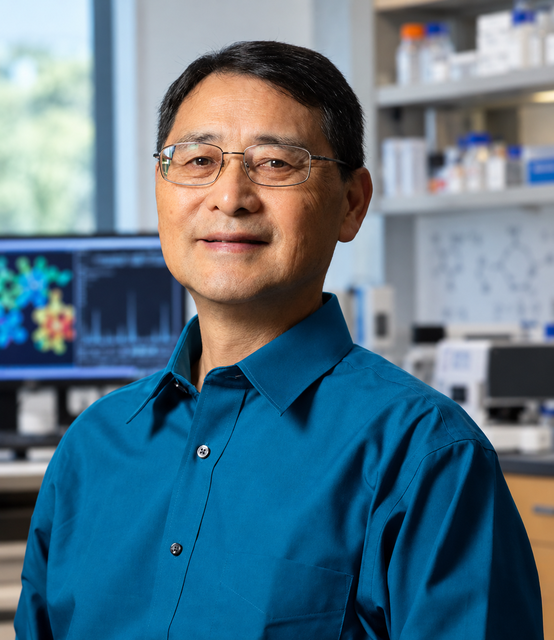
Guowei Wei, Ph.D.
Mathematical Biosciences and Artificial Intelligence
The University of Georgia
Recruited: 2026
Guowei Wei is a mathematician who builds mathematical AI models to advance drug discovery, virology, molecular modeling and biomedical imaging. His software reads the three-dimensional shape of a molecule and predicts how it will behave: how tightly a drug grips its target, or how a mutation changes a virus.
AI methods built for text and images have trouble ascertaining a molecule's 3D shape. Wei uses advanced mathematics such as algebraic topology, differential geometry, commutative algebra and topological spectral theory to compress that shape into mathematical invariants. He helped found the field now called topological deep learning, which maps the hidden, intricate geometry of molecules and protein binding sites.
Wei was recruited to the University of Georgia in 2026 from Michigan State University, where he spent several years as a Research Foundation Distinguished Professor.
RESEARCH
- Opened new ways for AI to understand the “shape” of information. Data is much more than a numeric list – it has patterns that take the form of loops, holes and clusters. Using highly sophisticated mathematical techniques to detect these hidden shapes, Wei’s team created new AI methods that can “see” patterns older approaches miss.
- Established mathematical AI as a winning tool in drug design. In the D3R Grand Challenge, a worldwide competition in computer-aided drug design, teams predict how drug candidates bind their protein targets. Wei's group was a top competitor for three straight years; in one round, it ranked first in 10 of 26 tasks.
- Forecast which coronavirus variants would take over next. Wei's models predict how a variant's mutations change its grip on human cells and its escape from antibodies. In February 2022, they projected that Omicron BA.2 would dominate. Within weeks that strain made up about 75% of sequenced cases worldwide.
- Identified vaccine resistance as a second force steering the evolution of SARS-CoV-2. Wei’s team used computer models to identify mutations that could help SARS-CoV-2 escape antibodies. They then tracked those mutations across more than 2.2 million virus genomes and compared their spread with vaccination rates. They found a strong relationship between higher vaccination rates and the growing frequency of some antibody-evading mutations. This suggested that escaping immune defenses was key to the virus’s evolution.
OUTSIDE THE LAB
Wei's drug-discovery research has received grant support from pharmaceutical companies Bristol-Myers Squibb and Pfizer, and he has worked with research partners at both companies.
SELECT HONORS
Fellow, Society for Industrial and Applied Mathematics (2026)
Fellow, American Institute for Medical and Biological Engineering (2023)
Choosing Georgia
“I moved to the University of Georgia because of its highly collaborative research environment and its strong institutional support for emerging areas of AI research. This environment is particularly well-aligned with the interdisciplinary direction I want to pursue in the next stage of my career.”