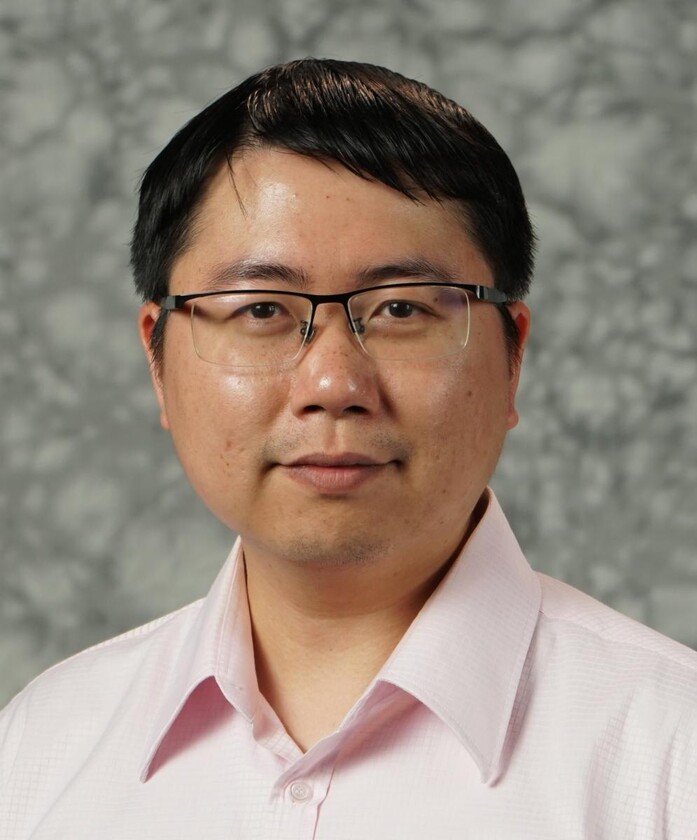
Shimeng Yu, Ph.D.
Director
Laboratory for Emerging Devices and Circuits
Georgia Institute of Technology
Shimeng Yu leads the Laboratory for Emerging Devices and Circuits at Georgia Tech, which designs energy-efficient computing systems based on emerging semiconductor devices and 3D integration technologies. He is also professor of electrical and computer engineering and holds the Dean’s professorship, a five-year appointment made in 2024 to recognize exceptional scholarship and service to the Institute.
Yu’s research focuses on the design, fabrication and modeling of advanced logic and memory devices beyond the scaling limit predicted by Moore's law. His work addresses issues related to the memory-wall problem in computer architecture. By integrating memory components closer to compute units together with 3D integration, his research aims to provide unprecedented bandwidth for AI compute systems.
The primary challenge in current AI acceleration is the extensive data movement cost between the compute and memory components. Yu works to close that gap through innovations in a variety of memory technologies and 3D integration.
His research has received support from federal agencies like the National Science Foundation, the Defense Advanced Research Projects Agency (DARPA), Intelligence Advanced Research Projects Activity, and the Department of Education, as well as from industry sponsors such as the Semiconductor Research Corporation (SRC), Intel, the Taiwan Semiconductor Manufacturing Company, Samsung, SK Hynix, Qualcomm, Sony, IMEC, and Google.
Yu has been recognized by some of the top organizations in his field. He was named an IEEE Fellow for his contributions to non-volatile memories and in-memory computing, and won Intel's Outstanding Researcher Award for a prototype small-scale accelerator chip that is able to quantify uncertainty in modern computer hardware, allowing for improved computing robustness.
He leads the open-source NeuroSim platform that provides a benchmark tool for AI hardware that encompasses a wide range of technology flavors and supports machine learning algorithms from convolutional neural networks to transformers.
Yu came to Georgia Tech in 2018 from Arizona State University. He received a B.S. degree in microelectronics from Peking University in 2009, and M.S. and Ph.D. degrees in electrical engineering from Stanford University in 2011 and 2013, respectively.