March 17, 2026
Streamlining the path to market
GRA refreshes its Innovation & Entrepreneurship program
Last week the Georgia Research Alliance (GRA) convened university innovation leaders from across the state to introduce the next evolution of the Innovation & Entrepreneurship (I&E) program.
The updated program structure was introduced by Justin Burns, GRA’s chief innovation officer, during a gathering of university representatives and research innovation leaders at the University of Georgia Innovation District and Innovation Gateway.
Since its launch in 2003, the I&E program has helped university discoveries move from research labs toward products, companies and solutions that improve lives and strengthen Georgia’s innovation economy.
Over the past decade, the program has supported hundreds of translational research projects and helped launch new technology ventures across the state. To date, the I&E program has:
• Invested $61 million to advance university inventions toward commercialization (enabling licensing and startup formation)
• Supported 682 grants to universities to develop new technologies
• Deployed 98 startup loans to early-stage companies
The return on Georgia’s investment in this activity has been nothing short of phenomenal.
By the start of 2026, the startups had generated over $2.1 billion in annual revenue – and attracted another $2.5 billion in investment, most of it from outside Georgia. Meaning: I&E’s investment and guidance is continuously returning dollars to Georgia’ tax base through startup growth and revenue.
In Fiscal Year 2025 alone, GRA-backed companies generated:
• $115 million in follow on investment
• $220 million in revenue
• More than 1,200 jobs across the state
Closing the translational gap
GRA’s Innovation & Entrepreneurship program focuses on one of the most challenging stages in the innovation pipeline: The period after a discovery is made but before it’s ready to raise outside capital.
At this crucial stage, technologies often require additional development, validation and early testing before they’re ready to advance toward the marketplace. GRA’s role is to help research teams move technologies through those critical development milestones.
A clearer pathway for translational funding
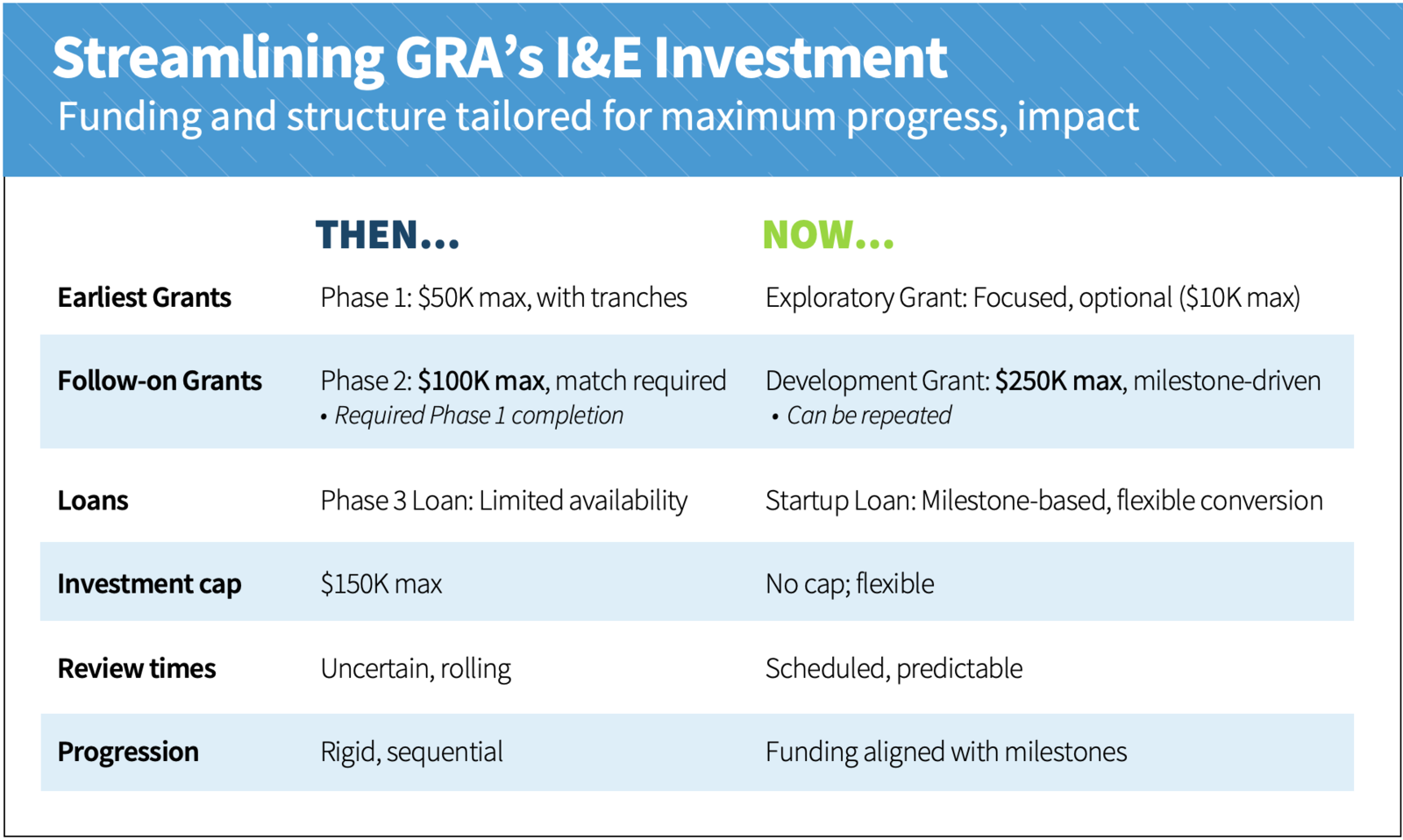
The newly refreshed I&E program introduces a streamlined funding structure designed to better match the needs of research teams and the realities of technology commercialization.
Two grant mechanisms support university-based translational work.
1. Exploratory Grants
Up to $10,000 to answer a focused question about a technology’s feasibility or potential application. These projects are designed to generate a clear technical or commercial insight before committing to a larger development effort.
2. Development Grants
$10,000 to $250,000 to support milestone-driven projects that significantly advance technologies toward commercialization or startup formation.
In addition, once a startup company forms around a Georgia university technology, GRA may provide Startup Loans to support early company development and bridge the gap to external financing.
A program built around milestones
The I&E program is designed around objective milestone-driven development.
Rather than funding open-ended research, GRA invests in projects with clearly defined technical or commercialization questions and measurable outcomes. Strong proposals demonstrate how a technology compares to — or outperforms — existing solutions. They also define milestones that create clear “go or no-go” decisions.
This approach ensures that projects generate the evidence needed to advance to the next stage of development.
“Georgia’s universities produce many remarkable discoveries every year,” said Justin Burns, chief innovation officer at the Georgia Research Alliance. “Our goal with this program refresh was to make the path from discovery to commercialization clearer and more effective for research teams. By focusing on milestone-driven development and closer collaboration with university partners, we can help more technologies reach the point where startups, investors and new ventures can take them forward.”
Filling a critical need
Georgia’s research universities continue to generate discoveries across fields such as life sciences, engineering, software, advanced materials and agricultural technology.
Through the Innovation & Entrepreneurship program, GRA aims to ensure these discoveries move beyond the lab toward companies, technologies and solutions that create long-term impact for Georgia.
The next generation of Georgia startups may already be forming in university labs across the state. And GRA will be there to help them reach the next stage.