June 29, 2026
Engineers of Innovation
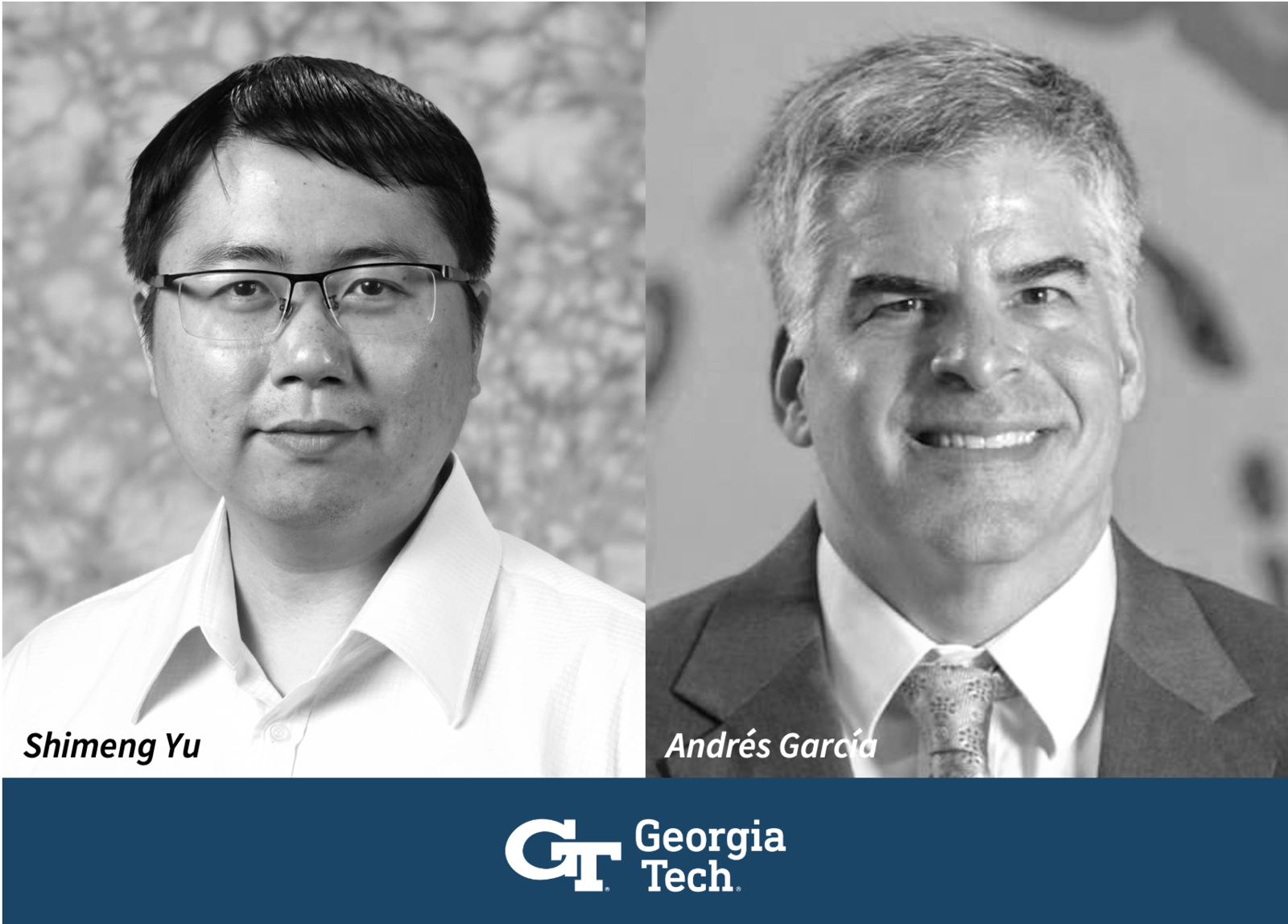
Andrés García and Shimeng Yu join the GRA Academy as Senior Fellows
If only there were a way to keep the body from attacking the transplanted cells that are trying to heal it.
If only the designers of AI microchips had a tool to simulate and test their designs to speed progress.
These formidable “if-only” challenges have been tackled by a pair of Georgia Tech researchers – the first by Andrés García, the second by Shimeng Yu. Both found promising solutions.
And this month, GRA announced that the pair of pioneering leaders have been named GRA Senior Fellows.
As part of the GRA Academy, the Senior Fellows are accomplished researchers leading science or technology centers are engines of discovery. The centers also elevate Georgia's profile and national competitiveness in research.
García and Yu lead such enterprises at Georgia Tech, both of which are breaking new ground in their fields and bringing several millions in public and private research funding to Georgia each year. Now, they join four prominent scientists in a specialized realm of the GRA Academy.
“Solving monumental challenges in our world today often requires a collective ingenuity like the kind we see in major research centers at Georgia’s universities,” says GRA President and CEO Tim Denning. “As with other GRA Senior Fellows, Andres Garcia and Shimeng Yu lead such enterprises at Georgia Tech. These centers not only produce solutions to real problems — they also attract significant investment from outside our state and prepare the next generation of science and technology talent. Both will be valuable additions to the GRA Academy.”
True trailblazers
At Georgia Tech, Andrés García has built an international reputation as a researcher whose discoveries helped advance the fields of regenerative medicine, biomaterials and stem cell engineering. His work blends biology and engineering to develop materials that “talk” to living cells, instructing them to heal a wound, regrow bone, accept a transplanted organ or behave in other helpful ways.
One example is a treatment for type 1 diabetes. Doctors sometimes transplant a donor’s islet cells, which produce insulin; but the procedure necessitates the use of toxic drugs to keep the immune system from attacking the transplanted cells.
García helped develop a synthetic hydrogel, coated with a protein, that trains the body to accept the transplanted cells. He became the scientific founder of a company that’s now working to advance the treatment toward the clinic. The same approach could one day extend beyond diabetes to other diseases, including liver failure. It could even work for transplanted organs like kidneys and hearts.
Shimeng Yu is equally accomplished, especially in developing new types of computer memory to make AI hardware faster and more energy efficient. His work centers on reducing a bottleneck in computing – the shuttling of data back and forth between memory and processing, which burns huge amounts of time and energy.
Yu has demonstrated ways to combine that memory and computation on the same chip by using ferroelectric materials and advanced memory technology. His team has built prototype chips that can perform AI calculations much faster and with far less power consumption than conventional approaches. He’s also been a pioneer in neuromorphic computing, a field that seeks to design computers that work more like the human brain.
The tool Yu developed to help chip developers their designs is called NeuroSim. Designers around the world use it to simulate and benchmark potential chips at the circuit, device and algorithm levels long before manufacturing. Yu's group released it publicly so other researchers and companies worldwide could use it for free – giving the AI hardware research community an invaluable way to compare competing memory technologies.
Leadership is part of their contribution
Yu directs Georgia Tech’s Laboratory for Emerging Devices and Circuits, which has emerged as a leader in creating the hardware foundation for next-generation AI. It functions as a complete ecosystem that explores new architectures, capacitors, devices and hardware to accelerate computing while using less power.
The lab is important for one other reason: It builds. Under Yu’s leadership, the lab has demonstrated working AI chips to perform calculations inside a single memory array. One notable example is a monolithically integrated resistive-memory (RRAM) chip that achieved major improvements in throughput and energy efficiency compared with previous approaches.
García is executive director of the renowned Parker H. Petit Institute for Bioengineering and Bioscience, founded in 1995. With over 300 researchers and 1,300 students and postdoc trainees, the Petit Institute is one of the nation’s largest bioengineering research hubs.
It’s also created a model for how scientists and engineers work together to advance regenerative medicine and create new medical technologies. Petit Institute researchers develop technologies that improve diagnosis, make treatments more effective and help patients recover from injury and illness.
Other trails to be blazed…
Both García and Yu have accomplished so much more through research than the two examples presented here. They’re also driven to see good ideas put to work to benefit humankind.
Yu recently launched CIMTech.ai, a startup that’s developing next-generation memory hardware for computers. García has been the entrepreneurial force behind three companies, each improving regenerative medicine in a different way. GRA’s Innovation & Entrepreneurship program has invested in all four of these enterprises.